
- Jupyter notebooks containing the python scripts associated with the computational examples and with certain figures
- Electronic forms of all figures in the book
- Available weblinks to references cited in the text
- Bonus material (e.g., videos, lecture notes, additional text and figures)
- Known errata.
Overall, Synchrotron Light: A Physics Journey from Laboratory to Cosmos stands as a comprehensive and thoughtfully structured text that spans much of modern physics. In thinking again about the Crab Nebula, one may wonder: what is the cosmic equivalent of the radio-frequency power in the cosmos to replenish the energy lost to synchrotron radiation?! This book provides the answer. The inclusion of exercises and extensive references at the end of each chapter, together with a detailed 23-page subject index, enhances its utility for students and instructors alike. It fully supports the publisher’s claim that it ‘takes the reader across the landscape of physics.’ […] The book’s extensive treatments across its 736 pages will make it an invaluable book on theory that I firmly recommend. John R. Helliwell, (26 Nov 2025): Synchrotron light: a physics journey from laboratory to cosmos, Crystallography Reviews, DOI: 10.1080/0889311X.2025.2590765More detailed description of book:
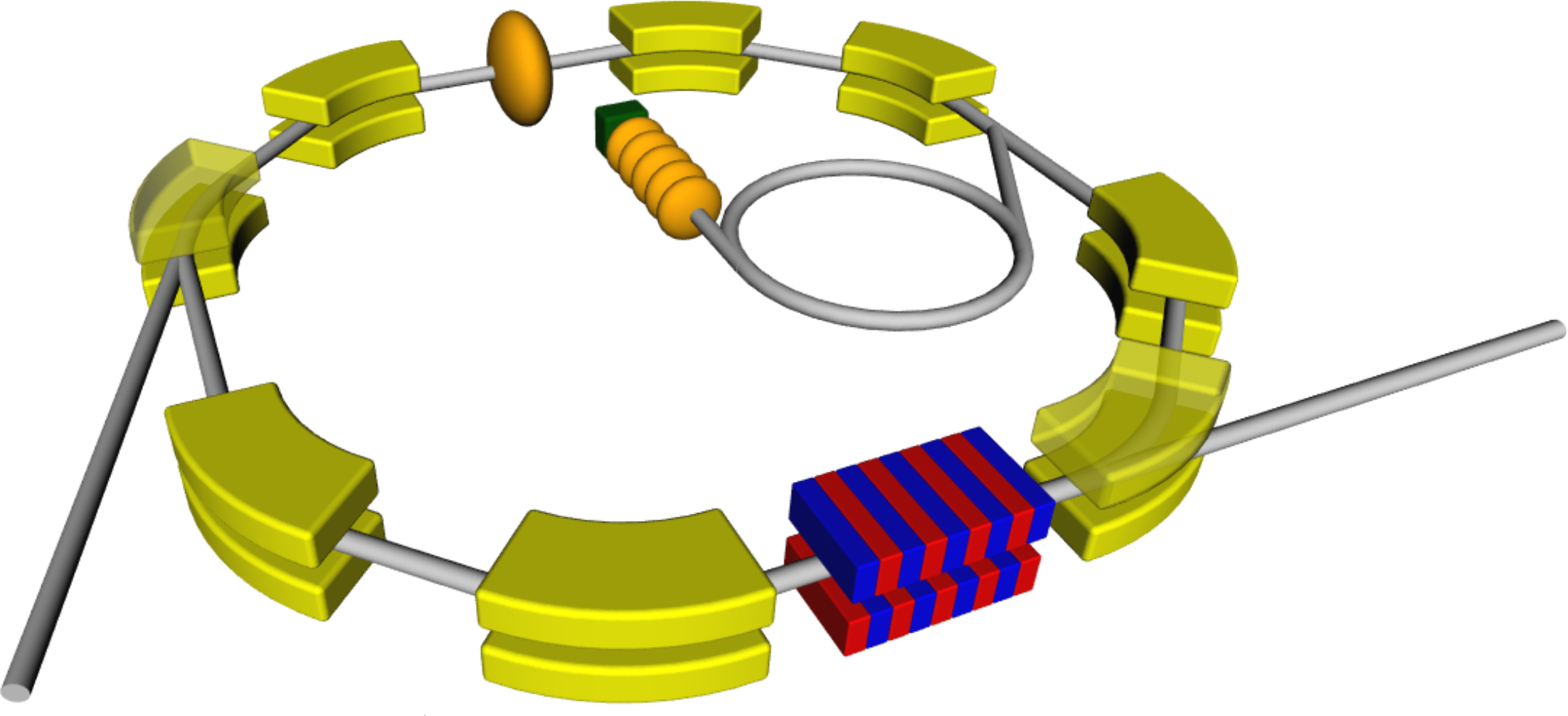
The physics of synchrotron-light emission is an established field, and the generation and use of synchrotron light is nowadays a mature technology. This book provides a broad introduction to the topic in an easy-to-read format, describing the fundamental underpinning physics, and combining rigorous treatment of the main concepts with a fresh outlook. The presentation is rich in images and graphics, that is typical of basic physics textbooks. All topics are described in a way that requires only upper-level undergraduate knowledge in physics and mathematics, and, with only a few exceptions, all results are derived from first principles. This book covers most of the well-known topics in the generation of synchrotron light by charged particles in accelerators and their special relativity and classical electrodynamics underpinnings. Synchrotron light, however, is much more pervasive throughout the broader fabric of physics than a cursory treatment would suggest. This book does justice to the centrality of the concept of synchrotron light, discussing the quantum mechanics and quantum optics aspects of synchrotron light, the generation of synchrotron light in the cosmos and its use in modern astrophysics, and finally the generalisations of the concept of synchrotron light to interactions other than the electromagnetic interaction. This book is a journey, or rather, multiple possible journeys across the landscape of physics. Through this variety of paths, the book aims at reaching several different communities in the quantitative physical sciences, and at bringing together a number of often-disconnected communities of learners and practitioners.
Brief table of contents:
1. Prologue 2. Introduction to special relativity 3. Emission from accelerated charges 4. Radiation emitted by charges in bending magnets 5. Insertion devices 6. Quantum effects in synchrotron radiation 7. Quantum effects in relativistic charged-particle orbits 8. The free-electron laser 9. Synchrotron light in the cosmos 10. Non-photon analogues of synchrotron radiation 11. Calculation of synchrotron radiation from first principles 12. Quantum optics of synchrotron light 13. Epilogue Appendix A – Bessel-function sums and trigonometric integrals Appendix B – Planck’s radiation law and radiometric quantities Appendix C – Schott’s pioneering contributions to synchrotron light Appendix D – Padé approximant for maximum-emission harmonic